

ICCA Iberian Chapter: Coimbra strengthens its global ambitions
27/03/2026
# tags: Coimbra , ICCA , Business Tourism
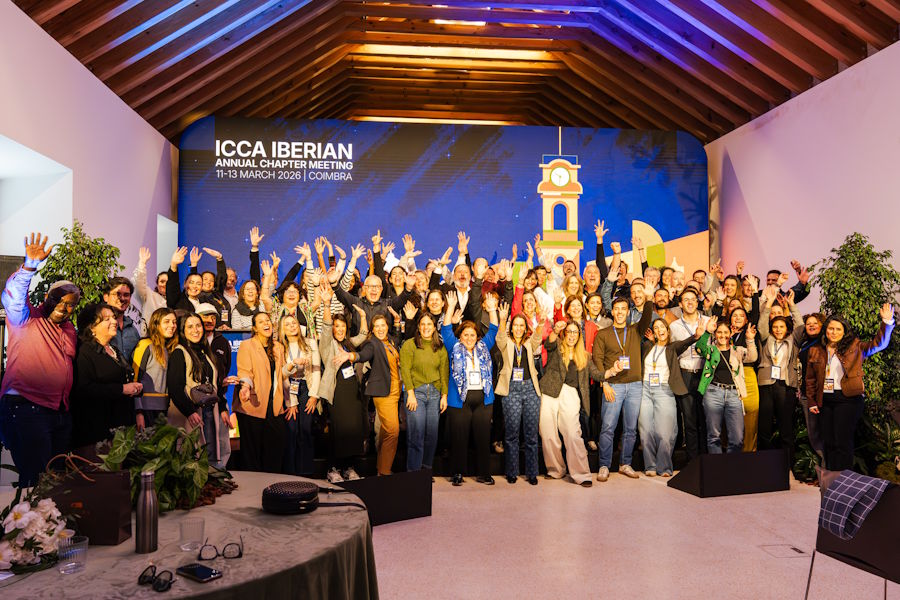
Meeting in Coimbra brings together 93 delegates and reinforces Iberian cooperation in attracting international congresses, with a focus on AI, sustainability and legacy.
Some meetings simply tick a box — others leave a lasting impression. The annual meeting of the ICCA Iberian Chapter, held in Coimbra from 11 to 13 March, clearly falls into the latter category.
The numbers help tell the story, but they do not explain it entirely. “The Coimbra meeting was an absolute success. We had a record attendance in Portugal of 93 delegates,” says Jorge Vinha da Silva, Chapter President. More than the figure itself, what matters is what it represents: “these 93 delegates together represent thousands of events.”
And that changes everything. Because, for a few days, Coimbra was not just a host city — it became a point of contact with a global ecosystem that ultimately decides where many of the world’s upcoming congresses will take place.
One of the most compelling aspects of the meeting was the way it opened itself up to the city and the wider region. It did not remain confined to meeting rooms or limited to industry insiders. “We held a masterclass on events with 95 university students,” as well as “a networking lunch and gathering with more than 60 companies from the Central region,” explains Jorge Vinha da Silva. There is a clear sense of legacy here that goes beyond rhetoric: engaging, empowering and, above all, building bridges.
Competing… by collaborating
In a sector where competition between destinations is fierce, the Iberian Peninsula appears to be playing a slightly different — or at least smarter — game.
“Yes, as a Chapter and as a region, we are even more competitive, as we have always been driven by a spirit of collaboration,” says the Chapter President. And this is not merely rhetoric: Lisbon, Barcelona and Madrid continue to rank among the ICCA global top destinations, demonstrating that Iberian scale can be a genuine advantage. Ultimately, the logic is less about “who wins” and more about “how we grow together”.
If there were any doubts about the transformation the sector is undergoing, Coimbra dispelled them. Artificial intelligence was at the heart of discussions, but it was far from the only topic.
“We always aim to address new or trending topics within the industry,” he notes, also pointing to debates around sustainability, legacy and evolving client expectations. The underlying question is simple: what does an event need today to remain relevant? The answer is less straightforward. But one certainty remains: “the human factor is tremendously important in a people-driven industry.”
The choice of Coimbra was no coincidence. There is a broader movement, visible across several countries, placing mid-sized destinations firmly on the radar of international congresses. “There is a growing focus on mid-sized cities with strong potential and rich cultural and heritage assets,” such as Coimbra, “which offers the infrastructure and business ecosystem capable of delivering quality,” he highlights.
Perhaps the most important point, however, lies elsewhere: these cities do not need to compete directly with major capitals. “There is no competition with large cities, but rather a complementarity that is very important for Portugal as a destination,” Vinha da Silva emphasises.
Not every destination seeking to enter this market succeeds. Here, the difference seems to lie less in facilities and more in mindset. “The best example I can give is precisely Coimbra,” says the Chapter President, highlighting the role of the Convention Bureau and the engagement of local stakeholders. The message is clear: when alignment exists, things happen — and they leave a mark. These 93 delegates “will be the best ambassadors for the destination, and I am certain they all returned home feeling a little bit ‘conimbricense’.”
Relationships that endure
In the end, this is what such gatherings do best: bringing together people who had not previously connected. “There is now a direct and closer relationship with 93 organisations that, until last week, had no connection with the destination,” notes Jorge Vinha da Silva. It may sound simple, but this is precisely where bids, partnerships and future events begin.
The next stop will be Bilbao, in 2027. For now, however, the focus is on capitalising on what Coimbra has already achieved. “We are still digesting Coimbra” and working to “help amplify its return,” he admits. Because, ultimately, each meeting is conceived from scratch: “Each year we create a ‘tailor-made suit’, because that is the only way it makes sense.”
The overarching goal remains unchanged: “To further develop our destinations globally — Portugal and Spain — and to increase their relevance on the international stage.”
