

Julius Solaris: “People need events more than ever”
20/04/2026
# tags: Trends , Events , Technology
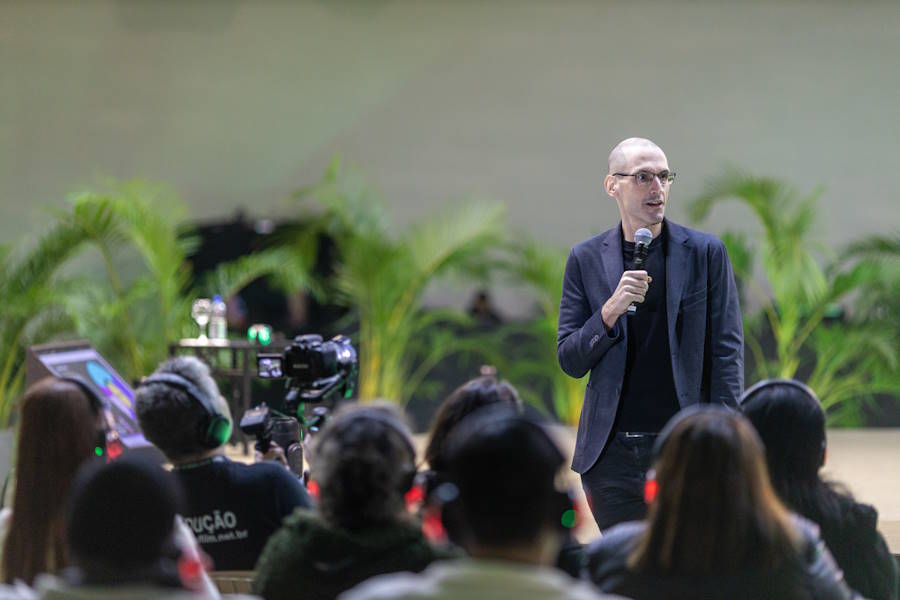
Julius Solaris, a well-known influencer in the events industry, was the keynote speaker at Oasis Connection, a Brazilian event promoted by events specialists Vanessa Martin, columnist for Event Point, Robson Lisboa and Vanessa Chiarelli Schabbel.
It was three intense days of exchange, inspiration and real connections, bringing together corporate and experiential event managers, communication agency leaders, activation creators and professionals with high decision-making power and influence.
Globally recognised as a leader in innovation and strategy in the events industry, inspiring and empowering professionals from around the world, Solaris agreed to speak to Event Point during the event.
In your opinion, what is the most overrated trend in the events industry today?
I think there is an effort to find the smartest trick through technology and activations, especially when it comes to hardware, physical technology. I feel like they are always very confusing. They always try to do something, but rarely impress. There is a desire among event professionals to appear technological, to appear advanced, rather than thinking about the essence of what we do and the fact that people are there to be with people. Not all technological stunts are necessarily exciting. When human beings are involved, for example, when they play with each other, do things with each other, they are much more engaged than, for example, when they touch screens or things like that. They are just gimmicks.
And what is the most underrated trend right now?
If we think about what really has an impact, from an organiser’s point of view, I think it’s the selection of destinations for events. It’s probably the most consequential decision you’re going to make, especially for the budget. So, there’s always been this conversation about tier two destinations, especially in the US, but also around the world. And I think event organisers and professionals are starting to think: where can I create a better experience for my audience? In a city that supports a better experience, that connects people better to each other, rather than taking them to the usual suspects.
How do you view the political landscape we are currently witnessing, especially in the United States? Do you have any thoughts on the matter?
I think what we are seeing right now in the US is happening in many, many countries. Unfortunately, when it comes to the negative aspects, this is definitely a global trend. The US is just the most prominent example. I am Italian, so I am very familiar with this reality. I don’t want to stigmatise anyone. Now, obviously, whenever travel is affected, whenever the ability to go and participate in events or travel for tourism is affected, as an industry, we suffer. And that is inevitable. In Las Vegas, tourism has dropped substantially, 13% compared to last year. This is not a good sign for our sector. Obviously, the US is a huge market, it can be self-sustaining. But for some types of events, association-oriented events, medical conferences, it is worrying. However, the good news is that the pandemic has taught us that we always have to have plans B and C, right? We are not in the business of being pessimistic in this industry. Otherwise, we would not be doing events.
We know that something will go wrong. We know that there is always a speaker who will not show up. So, the good news is that, first of all, we had a pandemic that taught us how to do virtual events, which can complement in-person experiences. But we also went through one of the worst inflations in recent years and two global conflicts. Now a third, right? However, events have been prolific. In the past, whenever there was a crisis, events were the first to be cut. And that is no longer happening. So that’s good news. People need events more than ever. So, whatever happens, we have to adapt. At the end of the day, the need for human connection currently outweighs everything else. It’s almost like the antidote to technology, social media and AI.
And are we managing to deliver the events that participants expect? What makes an event truly memorable for the audience?
I am in Brazil and I have just attended a session, a great session on AI, blockchain and the future. I will not remember a single word that was said there. I will remember the people I connected with. But this is not a stereotypical portrayal of the importance of people and human connection. To make it real means we have to plan events in a way that maximises connection. And ensure that people have the opportunity to come together, to learn from each other, to learn from experts, to learn about companies and brands, and to do business, which is fundamental to the business events sector. Let’s not forget that corporate events are about business, not just events.
In the past, we relied on serendipity as a strategy. Serendipity is not a strategy. Serendipity is the antithesis of planning. So, if we plan events, we structure serendipity, we maximise serendipity. Well, sometimes we forget that we expect connections to happen during the coffee break. Well, why aren’t you structuring that? Why not make the coffee break a structured networking opportunity? Thinking that way, I believe, creates many more opportunities for a modern event.
You didn’t mention content... Is it not that important anymore?
That’s what the research says, right? As a speaker, I shouldn’t even be saying that (smile). We are facing the biggest generational change ever in the working population. After the pandemic, Generation X and Baby Boomers no longer attend events as much as Millennials and Generation Z. Therefore, there is a whole new audience for whom content is important, but they get content in a million different ways. So, content has a role, it still has a role. It’s the content that will pay the bills. If a boss has to approve someone going to an event, they need to see the agenda. They need to see who’s going to speak. But the kind of content people want is very practical. It’s very action-oriented, and it’s also a way to connect people more, to have sessions where people can come together. There is a moderator, there is a speaker who is part of the conversation. And that conversation immediately becomes more meaningful.
If you had to guess one major change that will redefine the events industry in the coming years, what would it be?
I come from events technology, so the technological side is always something I’m aware of. All the technology companies that currently exist in the events industry will disappear or be completely redefined. In the next two years, without a doubt. Whatever technology we currently use in the events industry, it’s Excel spreadsheets on steroids. There is nothing smart about the set of event technologies we have, zero. Some companies are obviously trying to innovate.
In terms of AI, do you think we are already using it well? How do you see the impact of AI on events? Will it be in measurement? In organisation? In logistics?
Right now, the biggest use of AI is content and marketing, which is probably the worst use you can make of AI at the moment, honestly. Especially if you’re planning sessions, I’ve seen session descriptions done with AI, which is very, very bad. It’s the worst thing you can do. You’re giving your product to AI without any critical understanding of what’s going on. These are sessions that need to attract people. But the opportunities to make sense of the data, again, for an audience that isn’t data-friendly, are immense. Think of thousands of feedback forms that are usually just sitting there without any action. They can immediately become a source of inspiration for your next event.
The data analysis part, which has traditionally been lacking in the industry, is the biggest opportunity for growth. Period. There’s no question about it. Then there are also content opportunities. The exchange we have, the capture of that content, whether it’s a session or an interaction at a stand. What happens with that? Normally, it’s the salesperson who needs to take notes, take a photo of the business card, go back to the office and maybe remember to put it in the CRM. Now, everything can be automated, sent immediately, evaluated immediately and prioritised immediately. This will help events to be more measurable and impactful.
© Cláudia Coutinho de Sousa Newsroom
claudia@eventpointinternational.com