Timor-Leste enters a new phase of tourism development
16/02/2026
# tags: MICE , Events , ATF , Asia , Tourism , Destinations
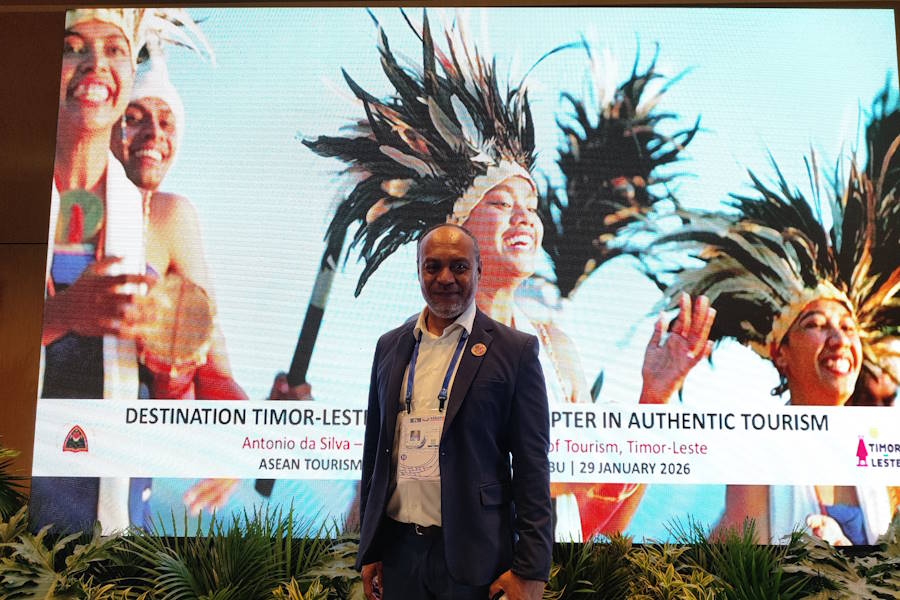
Timor-Leste is the newest member of the Association of Southeast Asian Nations (ASEAN), whose tourism-focused meeting (ATF 2026) took place in Cebu, Philippines, at the end of January.
The country joined ASEAN on October 26, 2025, becoming its 11th member and achieving a sense of regional belonging. More than just a diplomatic milestone, António da Silva, Director-General of Tourism at the Ministry of Tourism and Environment of Timor-Leste, believes that, for the tourism sector, integration into ASEAN means structural transformation.
For António da Silva, “real, unfiltered, unmanufactured authenticity” is a rare commodity in today's global tourism market. And Timor-Leste has it in abundance. It lies at the heart of the Coral Triangle and is home to 1,200 species of reef fish and over 400 species of coral; it offers diving, whale watching, and other experiences in waters that remain “vibrant and largely untouched”; it has 2,448 species of flora and fauna; it has Mount Ramelau, a 2,963-meter peak, for trekking; traditional arts, which include intricate basketry, wood carving, pottery, and tais textiles, recognized by UNESCO; as well as a blend of Indigenous traditions, Portuguese colonial influences, and Catholic heritage, traditional music, and dance. And coffee – the ‘Híbrido de Timor’, a variety unique to the country.
“As we strive to continue offering an authentic tourism product, we are also committed to ASEAN's principles of preserving, conserving, and promoting our natural, cultural, and historical heritage assets,” António da Silva assured attendees at the presentation session.
“Cooperation between nations is very important”
Belonging to ASEAN will “increase our capacity and raise our economic development goals. ASEAN is a large market and there is high potential for investment,” especially for tourism, said António da Silva in an interview with Event Point, noting that intra-ASEAN travel is “quite high.”
For him, “cooperation between nations is very important, not only in economic terms, but also politically.” Timor-Leste has joined the “ASEAN family, which is one of the largest economic regions in the world,” and as the newest member, it now has to “work hard” to align its policies and legislation with those of ASEAN.
“With regard to tourism, we have six or seven standards with which we need to align ourselves, which is not easy. We have the capacity to do so, but it takes time,” he acknowledged, highlighting the full support of the ASEAN secretariat throughout the process. The steps are being taken slowly, but there is a schedule to meet. And, following the established alphabetical order, Timor-Leste will host the ASEAN Tourism Forum as early as 2029. “It’s not long to go, but we are working hard on it.”
The country will strengthen the technical and professional skills of tourism workers. To this end, two initiatives will be launched: the Tourism Service Ambassador Program, for continuing education, and the review and updating of curricula in the sector to bring them into line with ASEAN standards.
By joining the association, Timor-Leste gains access to a range of resources for promoting the destination, as well as being able to use the Southeast Asia tourism logo and gain a presence on ASEAN communication channels. This integration will also enable participation in multi-destination tours, seamless trips that combine several countries in the region.
New conference center scheduled to open in 2028
Currently, Timor-Leste has several large hotels with meeting spaces and the government-owned Dili Convention Center. “It is a historic building, which was a market during the Portuguese era. Now, they are expanding its facilities,” said António da Silva. Depending on the format of the event, the venue can accommodate between 400 and 500 people.
António da Silva acknowledges the need to increase capacity, even by ASEAN MICE event standards. “There are certifications we need to have, such as food safety, engineering, and human resources certifications, including venue management, waste collection, and electricity standards,” he said.
Thus, at the time of joining ASEAN, Timor-Leste also began construction of a new International Conference Center in the old Dili Port, which, according to the official, will feature conference rooms, auditoriums, exhibition areas, and leisure facilities, and will be able to accommodate around 2,000 people. The inauguration is scheduled for 2028, in time to host the summit of Southeast Asian nations the following year.
Destination with enormous potential
Timor-Leste is focusing on several segments: those traveling for wellness, for educational purposes, those seeking diving, snorkeling, and whale watching activities, those interested in history, and also MICE travellers.
Currently, Timor-Leste receives around 30,000 visitors per year, “with modest but growing tourism infrastructure.” The potential is “enormous,” and António da Silva adds that there are countless investment opportunities and incentives. However, the idea is to strike a balance between the destination's capacity and the number of visitors, in order to maintain the quality of the offer and meet visitors' expectations. Otherwise, the destination's image could be damaged, he warns.
In terms of air connectivity, Timor-Leste has 31 direct international flights per week to Darwin (Australia), Xiamen and Fuzhou (China), Bali (Indonesia), Kuala Lumpur (Malaysia), and Singapore, operated by five airlines: Aero Dili, Air North, Batik Air, Citilink, and Qantas. Other direct flights are in the works. Cruise tourism is also being improved.
In terms of tourist accommodation, the destination currently has around 2,400 rooms. Two new luxury properties (Palm Springs Hotel and JL World Hotel) have added 200 quality rooms to the hotel offering over the last year, as well as meeting spaces. “We recognize the need to increase both the capacity and quality of our tourist accommodation to support the sustained growth of tourism,” acknowledged António da Silva at the presentation session.
To Event Point, he emphasized the historical connection between Timor-Leste and Portugal and noted that there are a considerable number of Portuguese visitors to the country, despite it not being among the main source markets. He also recalled the large community of countries in the region with links to Portugal, such as the Philippines, Malacca, Jakarta, Indonesia, and Macau.
* The journalist travelled at the invitation of ATF 2026